
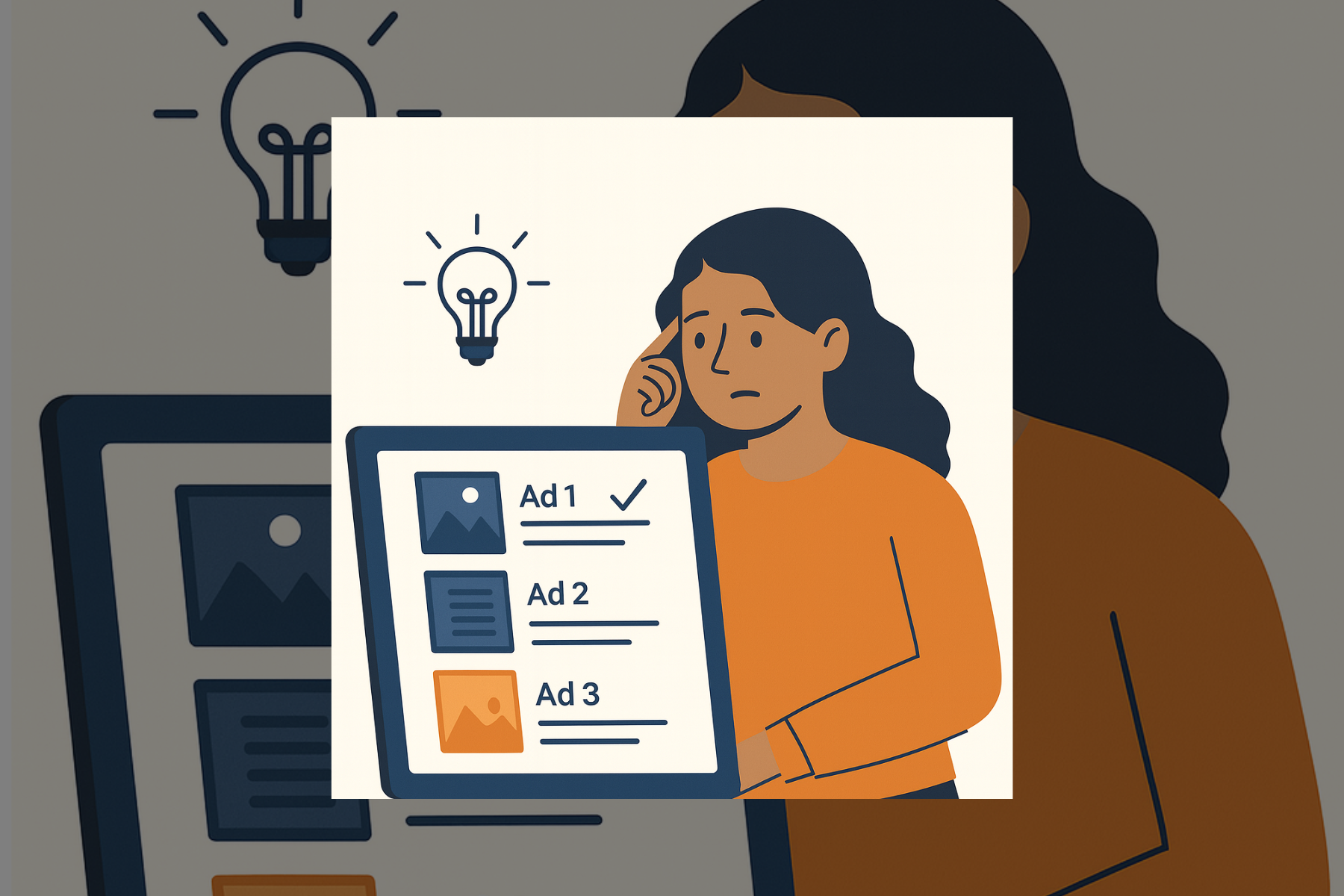
“We tried ads, and they didn’t work”
It’s the most common thing I hear from business owners:
It’s frustrating. You invest time, money, and energy—and nothing happens.
So you blame the platform. Or the algorithm. Or the market.
But here’s what the best-performing advertisers already know:
If your ads don’t work. It’s not the platform. It’s your ads.
Google, Meta, TikTok – they all want your money. Their systems are built to spend your budget. The only thing getting throttled is your creative.
That’s the uncomfortable truth. But it’s also the opportunity.
 Book a campaign audit here
The Real Reason Most Ads Fail
Here’s how most businesses approach paid ads:
Launch a few creatives, Let them run for a month, Cross their fingers and hopes some of them performs. That’s not marketing. That’s guessing.
The brands that consistently win aren’t guessing. They’re testing – again and again. Top advertisers don’t just throw ads out there. They split-test 10–15 times more than the average brand. They find out what works, then double down.
Where to Start: Test Your Headline First
If you’re wondering what to test first, always start with the headline. There’s a reason David Ogilvy famously said:
“When you’ve written your headline, you’ve spent eighty cents of your advertising dollar.” If your hook doesn’t catch attention, nothing else matters. Your audience scrolls past. Your ad gets ignored. Your budget burns for nothing.
How to Set Up Effective A/B Tests
Good advertisers don’t test everything at once.
One variable at a time. Always.
If you change the image, headline, and CTA in the same test, you’ll never know what moved the needle.
Example setup:
- ✅ Ad 1: Picture A + Copy A
- ✅ Ad 2: Picture A + Copy B
- ✅ Ad 3: Picture A + Copy C
Find the winning copy. Then move on to testing images. Then offers. Then CTAs.
It’s a process – not a one-time thing.
Why Speed Matters More Than Budget
The winners in paid ads aren’t the ones with the biggest pockets. They’re the ones who figure out what works faster. That’s why testing matters:
The faster you learn, the faster you scale.
Most businesses burn money on “okay” ads, then pause everything when they don’t see results. Top advertisers keep testing until they find the version that clicks.
Test → Learn → Adjust → Scale.
Stop guessing. Start testing.
Building for Today’s Platforms
Not long ago, running ads online was about one thing: finding the right audience. You could target based on interests, demographics, behaviors, and if you knew how to mix those levers, even average creative could work. The platforms rewarded the best tacticians.
But we’re not in 2019 anymore.
Interest targeting isn’t the golden ticket it used to be. Platforms like Meta, Google, and TikTok now have more than enough data to figure out who should see your ads. You can throw them broad targeting, and they’ll still find buyers.
That changes the game.
Today, creative is the targeting.
Your visuals, your copy, your message, they’re what qualify the right people and filter out the wrong ones. One great ad that speaks directly to your ideal customer will crush the most complex targeting setup with generic creative.
The brands winning right now know this: performance starts with the story you tell, not the settings in Ads Manager.
And while we’re not diving into how to craft killer creative here, I will walk you through how we structure campaigns so that your best content reaches the ideal customer, at exactly the right stage of the decision-making process.
Structuring Campaigns for Today’s Platforms
We’re not running campaigns just to show up in feeds. We’re building them to be remembered and acted on. That means getting the right message to the right people at the right moment.
At the top and middle of the funnel, our goal is awareness and trust. This is where educational ads, storytelling, and inspirational content shine. We’re not asking for the sale yet, we’re helping people name their problem, see possible solutions, and start linking our brand to that answer. The targeting is broad, but the creative is designed to spark curiosity and get them leaning in.
Move down the funnel, and the tone shifts. Now the audience knows who we are. They’ve seen our value, maybe browsed a product, maybe read a review. Here we give them a reason to act. Tutorials, sharp value proposition ads, and dynamic product ads show them exactly what they were looking at, when they were looking at it. This is where interest turns into intent.
We also split campaigns by country to make sure the message resonates locally. What works in Sweden won’t always land in Germany, so we tailor creative to each market from language to cultural cues.
Then there’s our sandbox split-testing. This is where we try new things: fresh creative angles, untested offers, and expansion into new markets. It keeps our campaigns from going stale and helps us find unexpected winners.
Finally, retargeting brings it all home. People who’ve interacted with us before get reminded why they clicked in the first place, whether through a product they viewed or a story they started but didn’t finish. This is where we turn warm interest into actual conversions.
When you put it all together, you’ve got a system where every penny works harder. It’s not one-size-fits-all. Every stage, every country, every test is intentional and every ad is built to meet people exactly where they are in their journey.
And based on this structure, we can now think about how to make our creatives.
The targeting is already baked into the framework, now it’s about producing the visuals, stories, and hooks that pull the right people in at each stage.
If you want to map this structure to your own campaigns, you can start sketching out the creative ideas today. Or skip the trial-and-error and let me do the campaign work for you.
I’m always happy to give you hands-on feedback you can steal and use right away. Email me, ping me on WhatsApp, or grab a slot in my calendar here.
Let’s get your ads in front of the right people, and make them impossible to ignore.
Leave a Reply